2019 started with a drought from January to late March, followed by heavy rain in April and May. The weather was quite unstable which led to uneven development of the vines. In addition to this there were two critical events in 2019: a hailstorm and rain forecast during harvest. The hailstorm that occurred on September 5th was quite localized and only affected certain areas. The rain however, affected everyone. Rain during harvest is not good, and so when the forecast predicted rain on October 15th, many growers harvested earlier than they would have liked. Weather is a fickle thing…
Many describe Barbera 2019 as a “traditional and classic” vintage. I, along with other winemakers I’ve spoken to, would agree. Alberto Viberti thinks 2019 is an elegant vintage for Barbera.
Tasting Notes Barbera 2019
Tasting notes below are in alphabetical order.
Alberto Viberti Barbera
Elegant and balanced Barbera. Good acidity and long finish. The wine has spent 6 months in oak but the only trace of oak is in the structure. Aromas of red fruits and berries.
Burlotto Barbera d’Alba
A powerful wine with an explosive nose. I almost get a hint of mint, along with dark red berries and some spices. Good acidity and long finish.
Cascina Fontana Barbera 2019
Amazing, explosive nose with aromas of darker fruit. Not as concentrated as many other Barbera 2019. A very balanced wine.
Emilio Vada Barbera d’Asti 2019
A barbera with an explosive nose. Fruity and mineral. Good acidity.
Fratelli Revello Barbera d’Alba
Dark red fruit and floral aromas. Explosive in the mouth. Fruity with good acidity.
Ghiomo Barbera Lavai
Giuseppino uses barrique for his Barbera because he thinks the two work well together. The only way you would know this wine had been in oak barrels is because of the excellent structure. No oak aromas. Only fresh fruits and berries.
La Vedetta Sarasino 2019
Beautiful nose! A fruity and fresh Barbera with good acidity.
Lalu Barbera d’Alba 2019
Balanced Barbera with a beautiful nose. Explosive nose, with aromas of red fruit. A very good wine.
Marengo Barbera 2019
This Barbera is quite explosive. Aromas of red berries and red fruit. Maybe a hint of spices. Quite structured, but balanced with good acidity.
Mauro Veglio Barbera d’Alba
A beautiful wine with aromas of red fruit. Juicy, with good acidity.
Nadia Curto Barbera d’Alba
Fresh and fruity with slightly warm aromas. Darker fruit and berries. Good acidity. 14.5% alcohol but you don’t feel it.
Vietti Barbera D’Alba Tre Vigne 2019
The Barbera d’Alba Tre Vigne was quite impressive. Fruity and floral on the nose, an aromatic wine. A very impressive wine.
Vietti Barbera d’Asti Tre Vigne2019
The Barbera d’Asti was not as aromatic as the Barbera d’Alba Tre Vigne. It’s also more crisp and more mineral, with aromas of red fruit.
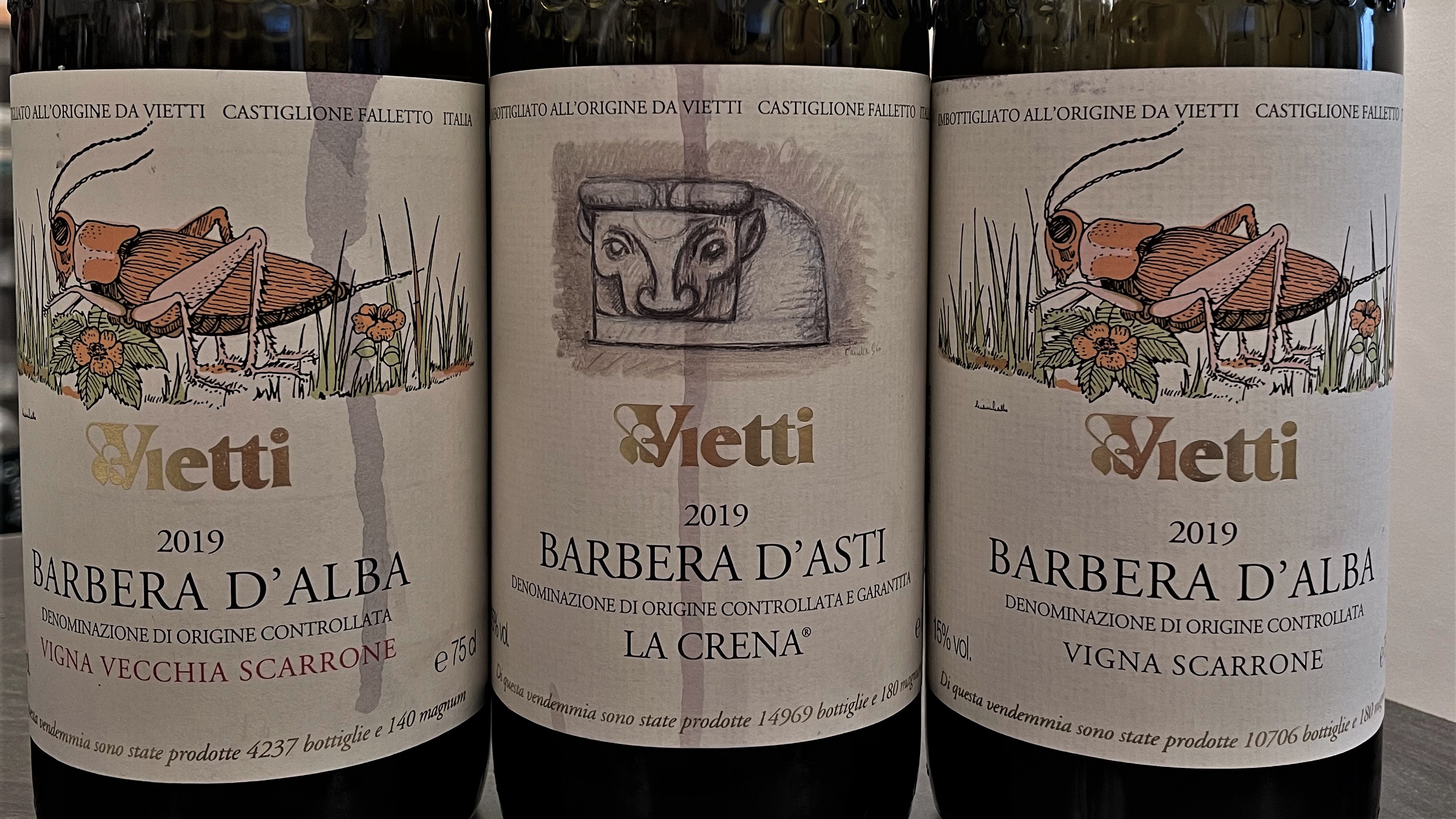
Vietti Barbera d’Alba Vigna Scarrone 2019
Aromas of red fruits, especially cherry. Also some spice notes. A complex, balanced Barbera.
Vietti Barbera d’Asti La Crena 2019
The La Crena was a bit more subtle on the nose compared to the Vigna Scarrone, but also more structured in the mouth. Aromas of red fruits and spices. Will probably benefit from some time in the bottle. Has excellent potential.
Vietti Barbera d’Alba Vigna Vecchia Scarrone 2019
A very young wine that opened up in the glass. Good structure with a long finish. A full bodied, complex Barbera.
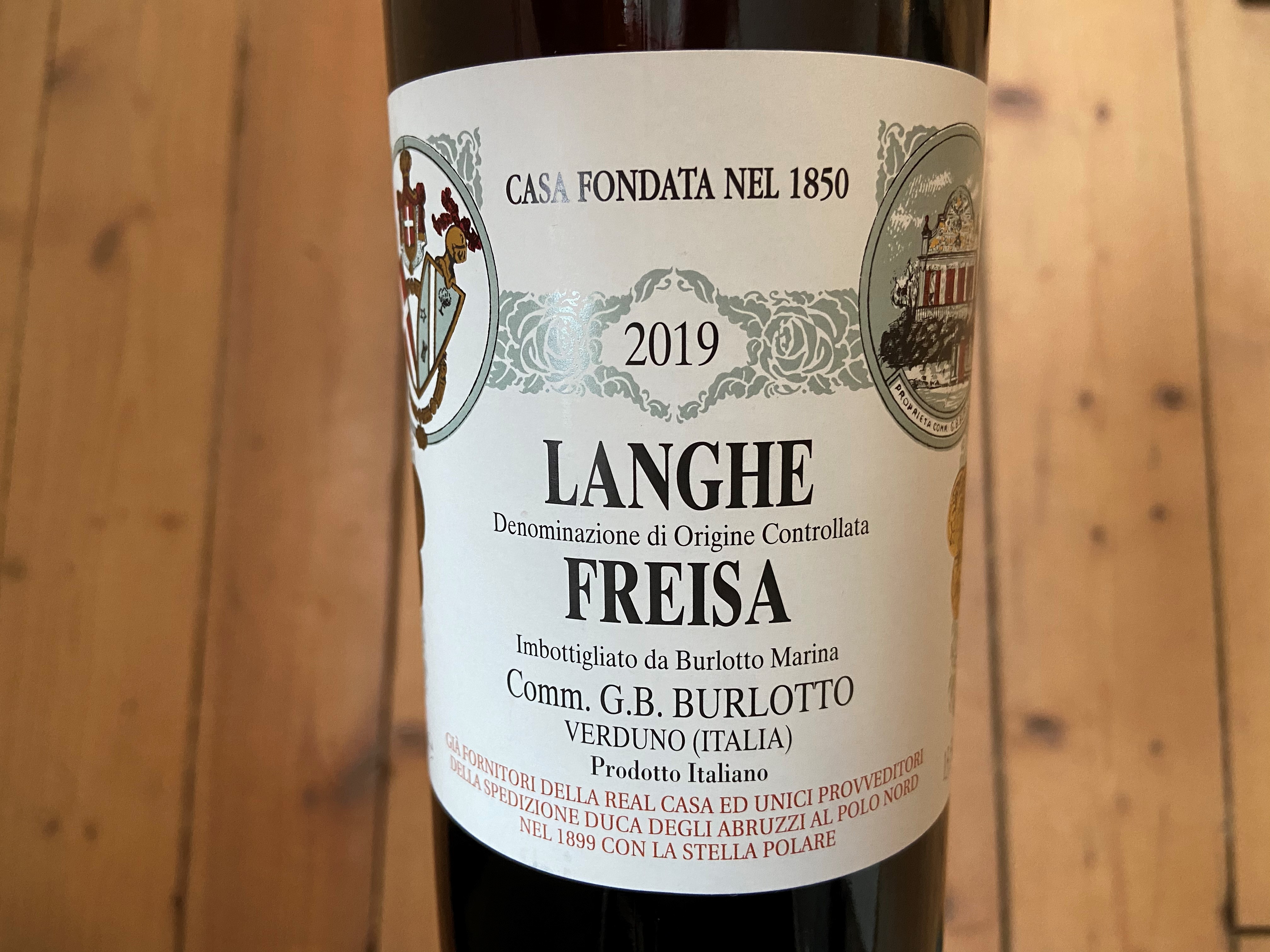
Burlotto Langhe Freisa is a wine that should not be forgotten. Freisa is an underappreciated grape, in my humble opinion, and should get some more attention. But before we dive into this underrated grape variety, let’s have a look at the history of G.B. Burlotto!
Burlotto
Giovan Battista Burlotto worked as a winemaker for seventy-seven years, and in that time he became world renowned. In addition to his accomplishments as a winemaker, he also made history by being the first to sell Barolo in bottle! After G.B. Burlotto’s death in 1927, the driving force behind the winery went with him and it wasn’t until his great-grandson Fabio Alessandria took over that the winery was brought back to its former glory.
Fabio continues the legacy of G.B., and has himself gained notoriety for his excellent work. His wines receive high marks and high praise from prominent wine critics. The focus is often on Barolo, and in the case of Burlotto, Monvigliero gets a lot of attention. But I think a good winemaker is defined not just by his Barolo, but the other wines like Dolcetto or Freisa. And Fabio does not disappoint!
Freisa
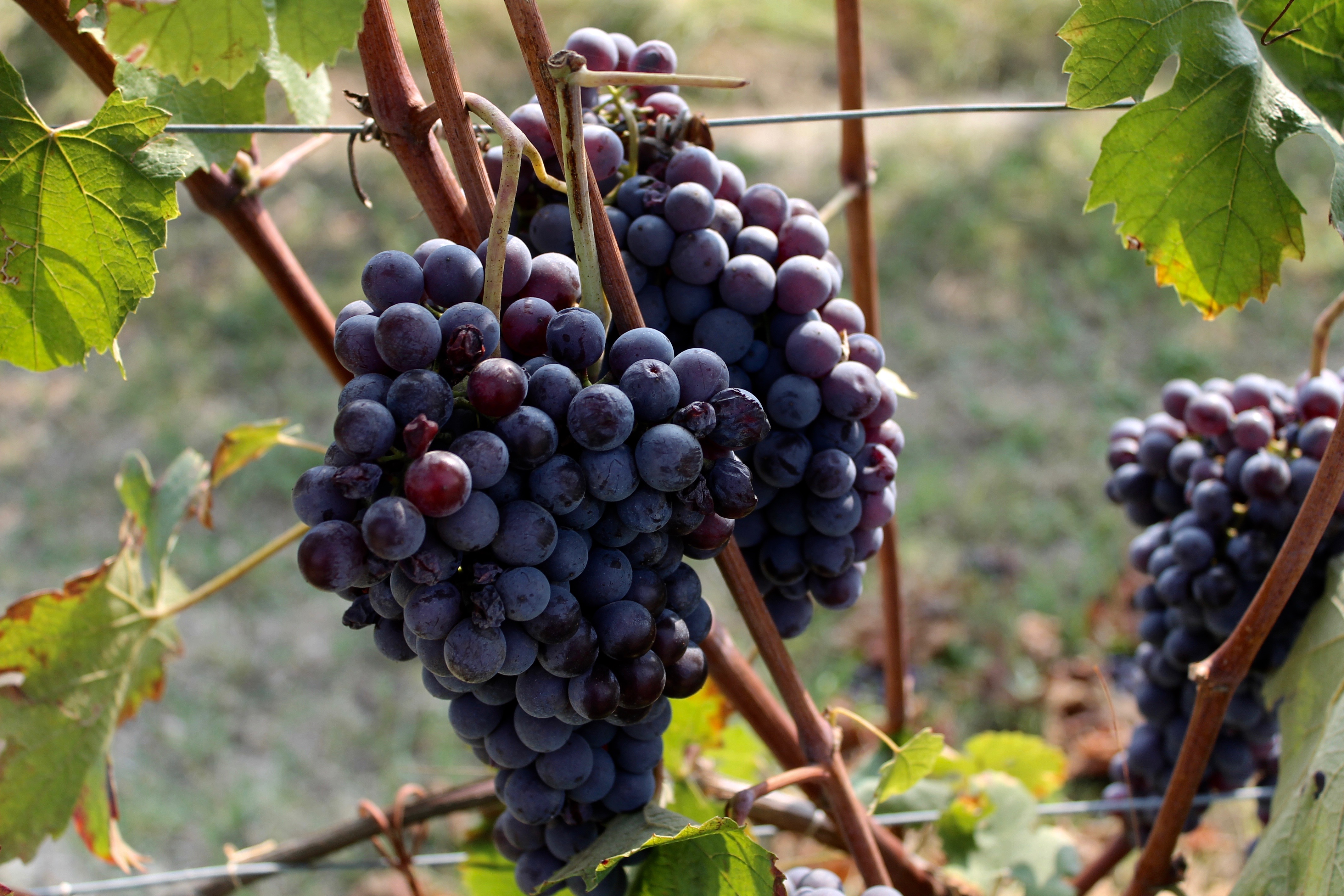
Freisa likely originates from Piemonte, and plantings date all the way back to the 18th century. Traditionally it was produced as a light sparkling wine, but today you’ll find full sparkling and still Freisa. Similar to Nebbiolo, Freisa has both tannins and acidity. Typical aromas are raspberry, strawberry and violets.
Burlotto Langhe Freisa 2019
The Burlotto Langhe Freisa 2019 is very fruity and fresh. On the nose you’ll find notes of red fruits and violet. It’s powerful, but elegant with soft tannins and medium acidity. A very balanced wine with a long finish.
Barolo 2014 gets a bad rap! With this vintage we truly see the power of wine journalists. What do I mean by that? Let me try and explain.
April showers bring May flowers
While this is a beautiful proverb, it was not the case in 2014. Instead of just April showers, it rained pretty much all of July. And not just a little bit of drizzle. It poured. I know, because I was there that year. It didn’t look good for the grapes and the winemakers were worried. And if that was not enough, the wine journalist and wine enthusiasts started to slam the 2014 vintage before the grapes were even harvested.
Here’s where it gets interesting: the weather picked up just in time for ripening season. While the Dolcetto and Freisa suffered quite a bit (also due to hail storms), the Barbera and Nebbiolo grapes were able to ripen just in time for harvest season. In the end, a year that seemed unsalvageable due to horrible weather conditions was indeed salvaged by good weather conditions.
The “Problem” with Barolo 2014
You’d think the winemakers would be happy with the way the vintage turned out. But, the damaged had already been done during the first half of the year. The 2014 vintage got such a bad rap that many had problems selling their wines. I think some still have 2014’s sitting in their cellar. In Norway, there are still Barolo 2014 available today, whereas the glorious 2016 vintage is sold out! And it’s such a shame because so many wonderful Barolos were made in 2014.
As Galloni said, “Navigating through the 2014 Barolo vintage is going to require a bit of work, although the time spent will be hugely rewarding.” And he is right. Good winemakers always make good wines, even in challenging years. Hard work pays off! And so while Barolo 2014 gets a bad rap, I’d encourage you to spend some time seeking out the great bottles that were made in this trying vintage. You’ll be pleasantly surprised!
Diego Barale in Cannubi
Tasting Notes Barolo 2014
Cascina Fontana Barolo
As Mario Fontana famously said: “The wine must reflect the season”. He said this while we tasted the Barolo 2014 together at his winery in July 2018. The wine was approachable and pleasant to drink, with plenty of fruit. It lacked a bit of structure, especially compared to the 2013 vintage but the wine did not live up to its “bad reputation.” In fact, it was quite the opposite!
Diego e Damiano Barale Barolo
Diego Barale has a soft spot for his 2014 Barolo. And I can see why. Beautiful aromas of roses, leather and liquorice jump out of the glass inviting you to taste it. The wine is light and fresh with smooth tannins making it very approachable. According to the brothers, they don’t feel their 2015 is ready yet. And while we wait for it to be ready we can drink the 2014. Which is what we did the summer of 2020.
Fratelli Alessandria Barolo
Blindtasted this against another wine October 2019 and I would NEVER have guessed it was 2014. Aromas of strawberries and other red fruit. Smooth but persistent tannins. Very fresh. A wonderful wine.
Giovanni Corino Barolo Arborina
Tasted this at the winery with Veronica Corino March 2018. As predicted, it did not have the same structure as 2013, but the wine did not feel like it was lacking anything. I think we should move away from using the terms “good” and “bad” when talking about vintages, and instead focus on the differences. Because every year is different. We just have to remember that different isn’t necessarily a bad thing.
Trediberri Rocche dell’Annunziata
A little closed on the nose when first opened, but after a while aromas of red fruits appeared. Good acidity, balances with a long finish. A fresh and approachable Barolo. Tasted in April 2019.
Vietti Barolo Lazzarito
Aromas of wet earth, mushroom, truffle and leather. Approachable, but perhaps a little green on the nose? Quite complex. Tasted this as a “pop and pour” at the winery August 2019. Would probably benefit from a little bit of air.
Barolo 2014 for my Norwegians:
There are still some Barolo 2014 available at Vinmonopolet!
Words used to describe Langhe Nebbiolo 2019: structure, powerful, round tannins, explosive nose, fruity, drinkable. I know you can’t put all Nebbiolo in the same basket, but some characteristics apply to many or all. I can also say that the results of 2019 are good. Just keep reading. Or better yet, go out and try some for yourself!
Climate
2019 started with a drought from January to late March, followed by heavy rain in April and May. The weather was quite unstable which led to uneven development of the vines. In addition to this there were two critical events in 2019: a hailstorm and rain forecast during harvest. The hailstorm that occurred on September 5th was quite localized and only affected certain areas. The rain however, affected everyone. Rain during harvest is not good, and so when the forecast predicted rain on October 15th, many growers harvested earlier than they would have liked. Weather is a fickle thing…
Despite all mentioned above, 2019 has proved to be a good vintage so far. Time will tell for Barolo, but the other wines like Langhe Nebbiolo 2019 are showing nicely. There is substantial acidity, and the alcohol is not excessive.
Below are my tasting notes in alphabetical order. Note that there are also some Nebbiolo d’Alba in here.
Alberto Viberti Langhe Nebbiolo
Aroma of cherries and other red fruit. Round tannins providing good structure.
Elio Grasso Gavarini Langhe Nebbiolo
Smells just like a Nebbiolo should smell. Explosive notes with aroma of red fruits and spices. Soft, round tannins, but still a powerful wine. A beautiful wine!
Emilio Vada Nebbiolo
Tasted blind. Beautiful nose. Strawberry and other red fruits. Excellent acidity. Balanced. Good structure. Very fresh and crisp.
Francesco Borgogno Langhe Nebbiolo
Floral and fruity aroma with hints of roses and strawberries. Typical Nebbiolo nose. Persistent in the mouth. Very fresh fruit. Crisp.
Ghiomo Vigna Granda Langhe Nebbiolo
Energetic wine with aroma of flowers and minerals. Soft tannins.
La Vedetta Langhe Nebbiolo
Beautiful nose, just how a Nebbiolo should smell. Very drinkable. Good structure.
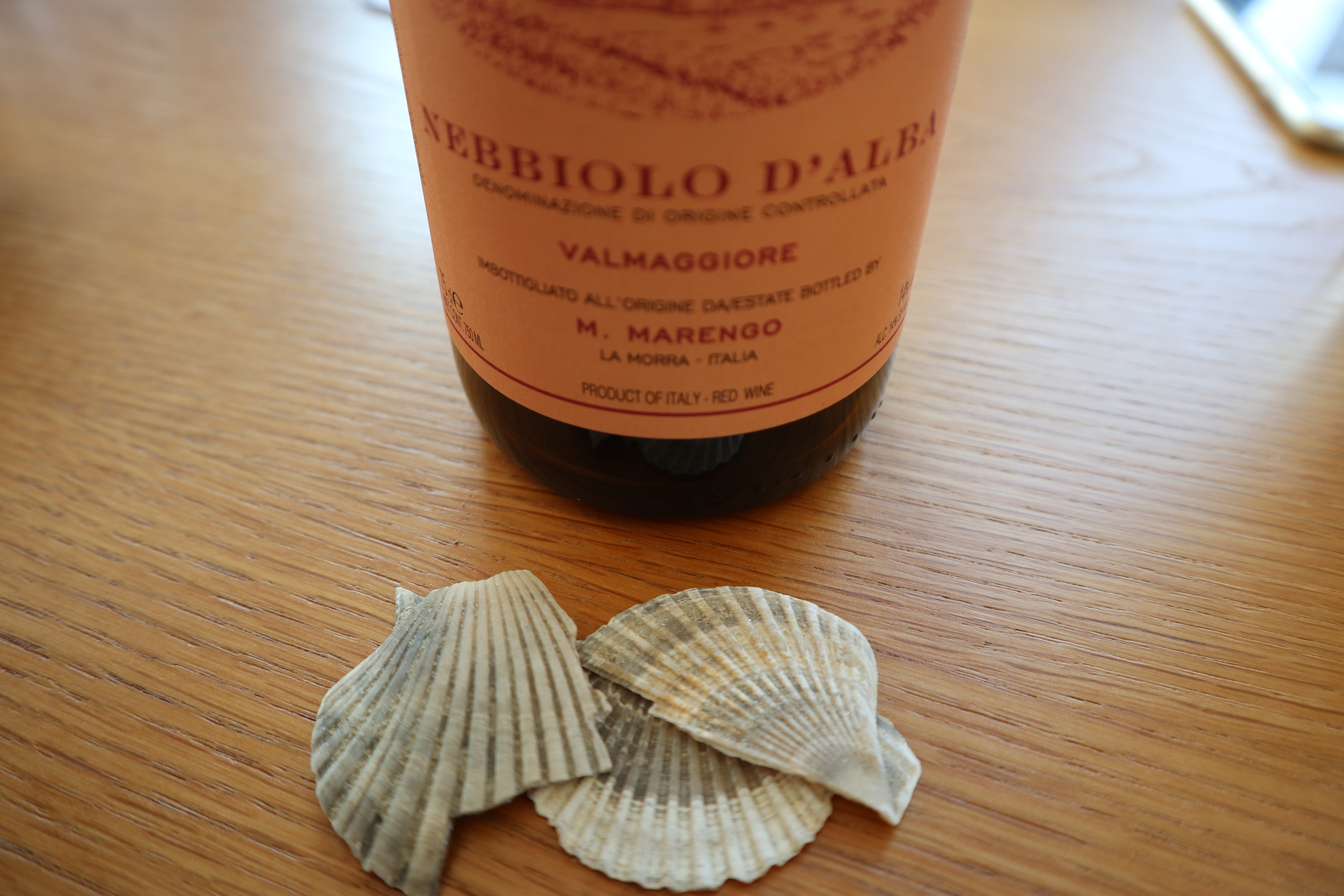
Marengo Nebbiolo d’Alba
Holy shit. Amazing nose with notes of red berries and rose petals. Very drinkable. Smooth tannins. Elegant wine.
Trediberri Langhe Nebbiolo
Explosive nose with aromas of flowers and fruit. Hints of tobacco, roses, red fruits. Firm, but elegant tannins that disappear quickly. A baby Barolo.
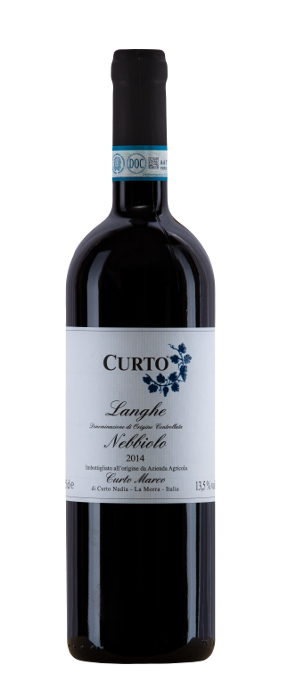
The grapes in the Nadia Curto Langhe Nebbiolo come from the Arborina vineyard! During fermentation Nadia proceeds with manual repassing and pressing. Nadia uses indigenous yeast. After a maceration of about 15 days, the wine is drawn off and after the malolactic fermentation the wine begins the refinement in wood for about a year. It is bottled in the summer months without clarification or filtration.
Nadia Curto Langhe Nebbiolo
2018
2018 was a difficult vintage, with a lot of rain and a lot of mildew. The Curto Nebbiolo is light with soft tannins. Beautiful nose, just like what a a nebbiolo should smell, with aromas of roses, fruit and cherry.
2016
2016 is considered one of the greatest vintages for Nebbiolo. Most people focus on Barolo, but I think the Nebbiolo’s should get a shoutout. The 2016 Langhe Nebbiolo from Nadia Curto is currently available in Norway!
2014
2014 was one of the most difficult vintages this decade. It rained and rained and rained. The wines are therefore quite light. The 2014 Curto Nebbiolo is quite elegant, with aromas of red fruits and roses.
Modernist or Traditionalist?
Modernist or Traditionalist? If there is anyone I know that doesn’t “belong” in any boxes, it’s Nadia Curto. Her winemaking style is influenced by both her father and her uncle, and she applies the different methods to different wines. Does it matter what style you prefer, if your wines are good? I don’t think so.
The Dolcetto 2019 are quite structured with lots of fruit. I find them to be a bit more complex, especially compared to 2018, giving the wine a little more “oomph”. One could argue that the Dolcetto from 2017 also had “oomph” but perhaps not complex. The warm temperature of the 2017 vintage gave the wines a bigger character, but also a lack of balance when it came to acidity and alcohol. Keep in mind, this is one person’s opinion and taste, opinions and tastes which might differ from yours.
I really like Dolcetto 2019. I know that is a general statement, but after tasting quite a few Dolcetto from 2019, I feel like I can be fairly general. Everything is relative, and my opinion may stem from the fact that I was not as impressed by Dolcetto in 2017 and 2018 as I am by 2019. Below are some of my tasting notes in alphabetical order. Enjoy!
Dolcetto 2019
Burlotto Dolcetto
Concentrated nose with aromas of cherry and red fruits. Also quite concentrated in the mouth. A beautiful Dolcetto!
A perfect Dolcetto nose. Elegant and rich with good structure. The grapes come from a vineyard in Sinio where the soil is composed of limestone with some clay. Mario vinifies his Dolcetto in stainless steel tanks.
Fruity and fresh, yet complex, both on the nose and in the mouth. Violets and dark berries on the nose. The vines, grown in San Giovanni, are 50 years old.
A powerful wine with a crisp nose. Fresh and fruity with good acidity. Aromas of blackcurrant, dark fruit and berries.
Marengo Dolcetto
Powerful aromas of dark berries. A good wine that’s easy to drink. Fruity. More structure than 2018
Nadia Curto Dolcetto
Nadia had an issue with storms in her Gattera vineyard where the Dolcetto grows. Maturation of the grapes was blocked due to the storm which resulted in a Dolcetto with a higher acidity. Aromas of blackcurrant, cherry and other dark berries.
As with most of the 2019 Dolcetto’s, the Paolo Scavino Dolcetto is quite structured. I really like it. Concentrated and explosive. Fruity with good length.
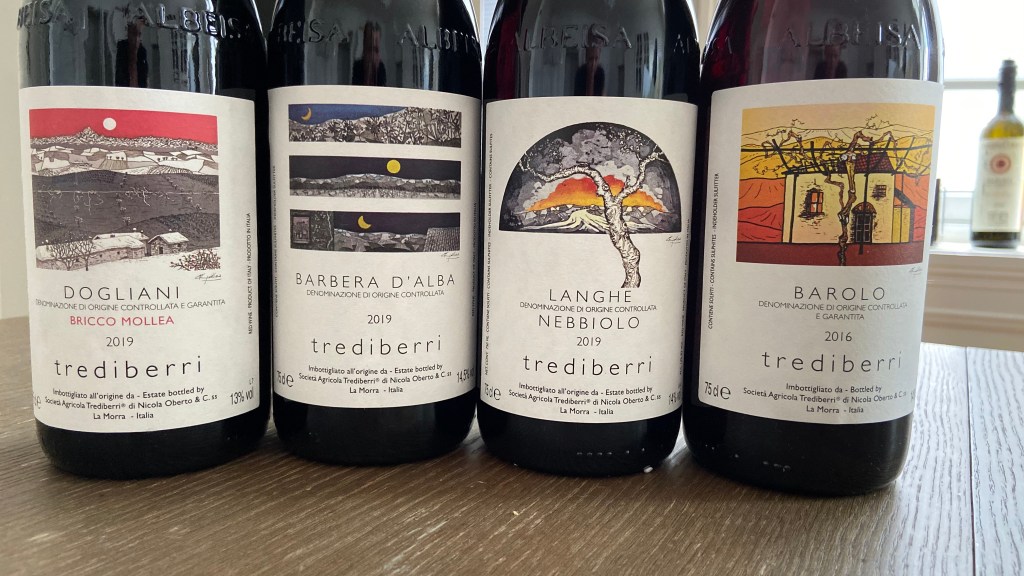
Trediberri Dogliani Bricco Mollea
The Bricco Mollea vineyard is located in Vicoforte, far south in Langhe. Dolcetto’s from Dogliani tend to be more intense than Dolcetto’s from La Morra, and if you combine the terroir with the 62 year old plants, you get a complex and intense Dolcetto.
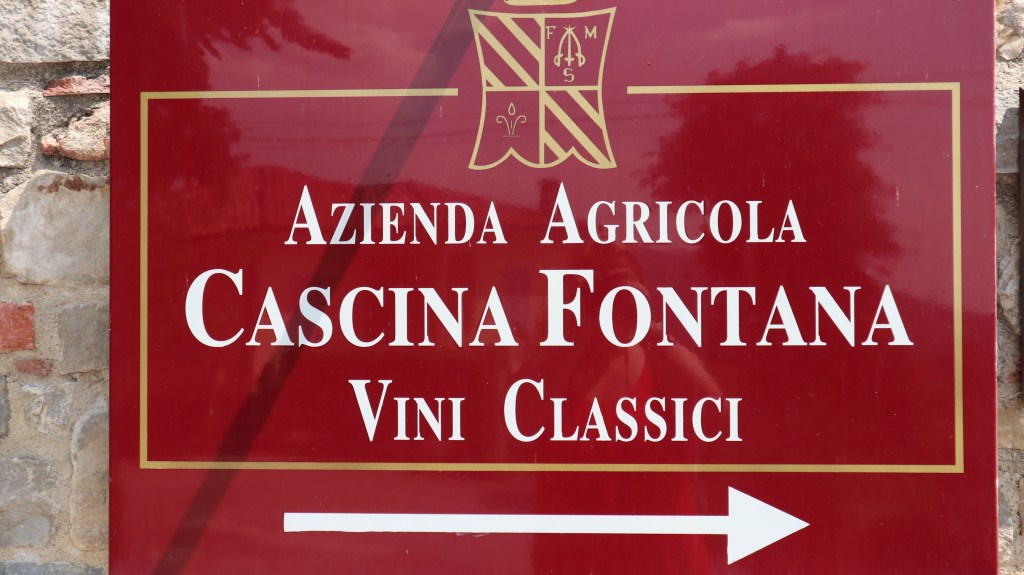
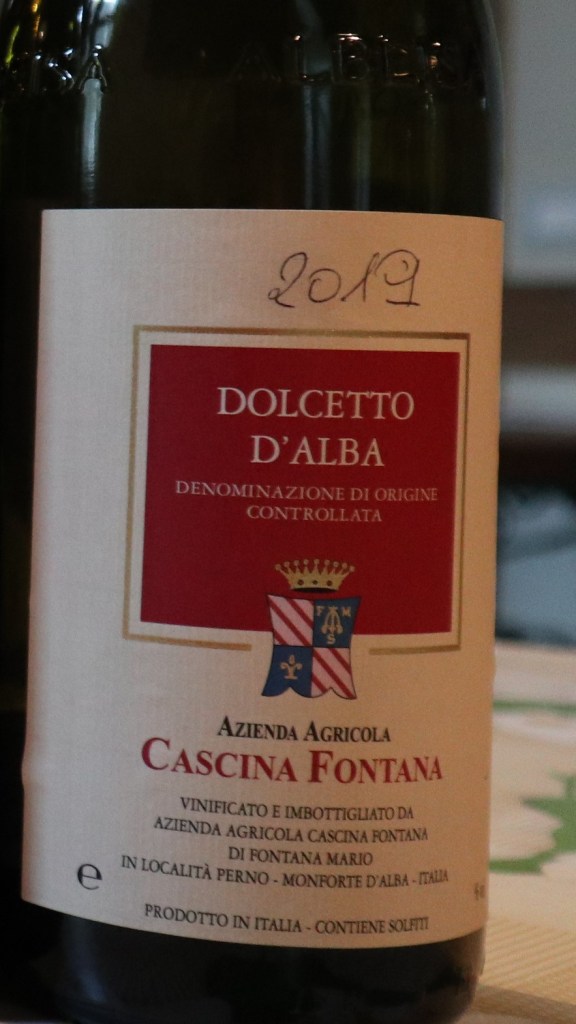
I bet you didn’t know that the Cascina Fontana Dolcetto holds a special place in Mario’s heart! Personally, I think Dolcetto is quite underrated. We don’t give it enough attention. And, as it turns out, the Dolcetto grape is not the easiest to deal with. But that doesn’t stop Mario! During my last visit we spent quite a bit of time talking about Dolcetto. Turns out it’s one of Mario’s favorite to grow. Even if it can be a pain in the a**!
Winemaking
The Cascina Fontana Dolcetto is aged in stainless steel tanks. The grapes come from a vineyard in Sinio, which is outside the DOCG area. The vineyard has soil composed of limestone with some clay. Something that is very important to Mario is the fact that the wine must reflect the vintage. He said this when talking about the 2014 vintage, but it also applies to any other vintage. As you can see below, the Dolcetto has quite different expressions in the separate vintages and I like all of them!
Cascina Fontana Dolcetto Tasting Notes
Dolcetto 2019
In the words of Mario Fontana: “2019 is a great vintage.” You have this perfect Dolcetto nose, good structure and wonderful freshness. I think the 2019 Dolcetto’s are elegant and rich, with more power than 2018.
Dolcetto 2018
As Nicola from Trediberri once said, the 2018 vintage is skinny just like Miley Cyrus. The 2018 Dolcetto is light and fruity – a very drinkable Dolcetto. Lacks the structure you find in 2017 and 2019, but structure isn’t always something you strive for in a Dolcetto.
Dolcetto 2017
Compared to 2019, 207 was a warm vintage, and so the alcohol is a little higher. The 2017 has 13.5% alcohol, but because Mario is such a wonderful winemaker, you cannot taste it!
Cascina Fontana Barolo 2016
You can find tasting notes on the Cascina Fontana 2016 Barolo’s here.
Barolo 2016 – the vintage to rule them all? Every vintage is different. Some are hot, some are cold, some are dry and some are wet. And then you have everything in between. Sometimes, you have a vintage where everything kind of lines up. 2016 is such a vintage.
What is the best weather, you might ask. The reason it’s hard to answer this question is the fact that each step of the way, the grapes need different things. You want rain in the growing season, but not too much. During the harvest, the absence of rain is preferred. It needs to be warm, but not too warm, and you also want the nights to be cooler toward the harvest, but not too cool. The grapes are indeed quite high maintenance.
But then you have the “magic” vintages. The weather in 2016 was just about as perfect as can get for the Nebbiolo grapes. The growing season was long, there was an absence of natural disasters like hail, the weather was stable toward the end of the season and the harvest was late.
Barolo 2016
A lot of good Barolos came out of 2016, but what struck me the most is the high quality of the classic blends compared to the Cru Barolos. The classic blends are usually simpler, less complicated and can sometimes be perceived as inferior to the Cru Barolos. But in 2016 the disparity between the two is much smaller. I found the blends to be approachable, elegant, fresh and complex. It might be the year to stock up on the classic blends and give your wallet a break.
Top 5
Among the Barolo 2016s I’ve tasted, a few stood out. The unifying aspect connecting these wines was the “wow” feeling I got when I tried them. They were more than good wines, there was something extraordinary about them.
Azelia Barolo Cerretta 2016 – Now we’re talking! A powerful Barolo with an explosive nose. Notes of chocolate, tobacco, fruit. Big but sweet tannins. Burlotto Barolo 2016 – Holy shit. An incredibly approachable Barolo with elegant tannins. On the nose you’ll find hints of spices, tobacco, some chocolate and violets. Diego e Damiano Barale Barolo 2016 – Smooth and elegant Barolo with notes of leather, roses and red fruit. Excellent structure with round but persistent tannins. Francesco Borgogno Barolo Brunate 2016 – Beautiful nose, just like a Brunate should smell. Elegant wine with a long finish. Hints of tar on the nose. Marengo Barolo Brunate 2016 – Holy tits on toast. Those were my exact notes. A beautiful nose – floral and fruity. Elegant tannins, very smooth. This wine has huge potential.
Note that our tastes may differ, and these are based on my personal preferences. The wines are sorted in alphabetical order.
Barolo 2016 Tasting Notes
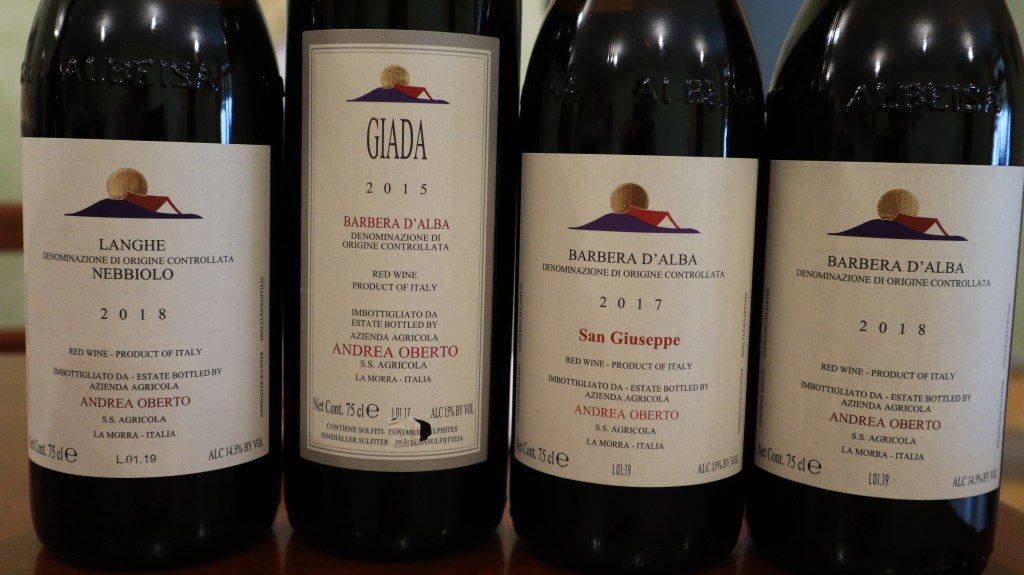
Andrea Oberto Barolo Commune di La Morra A very fresh Barolo with some balsamic notes. Hint of red fruit and tobacco. Tasted blind next to Barolo Rocche dell’Annunziata 2016 and Barolo Arbarella 2015.
Andrea Oberto Barolo Rocche dell’Annunziata Lovely floral and fruity nose. A big wine with sweet (round) tannins. My favorite Barolo 2016 from Andrea Oberto. Tasted blind next to Barolo 2016 and Barolo Arbarella 2015.
Andrea Oberto Barolo Albarella A very floral and feminine Barolo with hint of licorice. Tasted next to the Barolo Albarella 2015, and although 2015 is a good vintage, 2016 is definitely more expressive and approachable.
Azelia Barolo Floral and fruity nose, elegant tannins, good structure and long finish. A classic Barolo with grapes from Castiglione and Serralunga, giving the wine a good mix of feminine and masculine characteristics.
Azelia Barolo Margheria A powerful wine! Notes of tobacco, chocolate and spices.
Azelia Barolo San Rocco Another big wine from Azelia. Notes of chocolate and warm dark fruit.
Azelia Barolo Cerretta Now we’re talking! A powerful Barolo with an explosive nose. Notes of chocolate, tobacco, fruit. Big but sweet tannins.
Burlotto Barolo Holy shit. An incredibly approachable Barolo with elegant tannins. On the nose you’ll find hints of spices, tobacco, some chocolate and violets.
Burlotto Barolo Acclivi My first thought: What an extreme difference to the classic. The nose was so much more explosive. Roses, wet forest floor, spices. Smooth tannins. Spicy in the mouth.
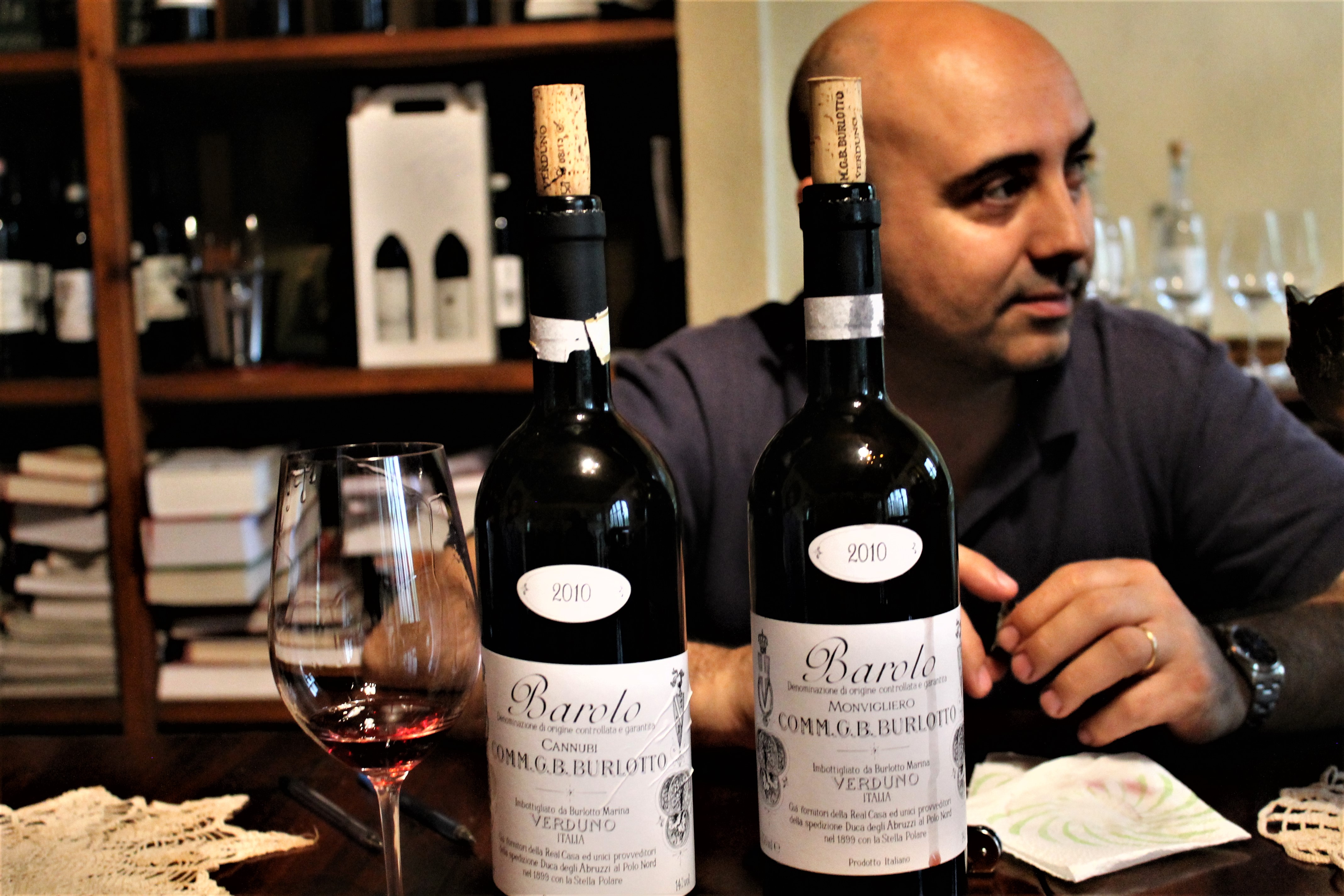
Burlotto Barolo Monvigliero Again, so different on the nose. Typical monvigliero notes, almost like perfume. Spicy and floral. Impressive wine that is both powerful and elegant at the same time, with a long finish.
Burlotto Barolo Cannubi Floral, fruity, fresh. Bigger in the mouth than the other three. Big but with sweet tannins, making it relatively approachable now. But this is a wine I would store for a while.
Cascina Fontana Barolo “A wine complete” – Mario. Everything is good – well integrated, good nose, good structure. Elegant with a long finish.
Cascina Fontana Barolo Castiglione More masculine notes compared to the classic Barolo. Bigger in the mouth, but still elegant.
Cavallotto Barolo Beautiful nose with notes of roses, fruit and leather. Very elegant tannins.
Cavallotto Barolo Vignolo Big but approachable. Notes of roses and tobacco. Long finish.
Chiara Boschis Barolo Cannubi Explosive nose, very feminine and fresh. A very elegant Barolo.
Chiara Boschis Barolo Nia Nuova Via Nuova is a lot bigger than Cannubi, more masculine.
Chiara Boschis Barolo Mosconi A big wine with a long finish. Can feel the Monforte tannins. Huge potential!
Diego e Damiano Barale Barolo Smooth and elegant Barolo with notes of leather, roses and red fruit. Excellent structure with round but persistent tannins.
Diego Morra Barolo Zinzasco Balsamic and tobacco on the nose with a hint of chocolate. Big round tannins but they go away quite quickly and then you’re left with beautiful fruit and chocolate.
Ettore Germano Barolo Prapo A powerful yet elegant Barolo with softer tannins.
Ettore Germano Barolo Cerretta More powerful and concentrated. Balsamic nose with hints of concentrated fruit. Powerful tannins, a rustic Barolo.
Francesco Borgogno Barolo Brunate Beautiful nose, just like a Brunate should smell. Elegant wine with a long finish. Hints of tar on the nose.
Fratelli Revello Barolo The Fratelli Revello Barolo 2016 seduces you with aromas of red berries, licorice, tobacco and roses. The wine is powerful yet elegant, with a round fruity feel backed up by a good structure.
Gianfranco Alessandria Barolo Notes of oak, spices and rose petals. Big tannins, typical of a Monforte Barolo. Very good, long finish.
Gianfranco Alessandria Barolo San Giovanni This Barolo smells just like e a Barolo should smell. Some oak notes in addition to notes of licorice, leather and cherries. Big in the mouth, a typical Monforte Barolo. A tad spicy with a long finish.
Luigi Pira Barolo Marenca A more masculine and austere Barolo, but also quite crisp and fresh. Notes of tobacco, spices and menthol.
Luigi Pira Barolo Vignarionda Beautiful nose with notes of roses, red fruit and chocolate. An explosive wine with a long finish.
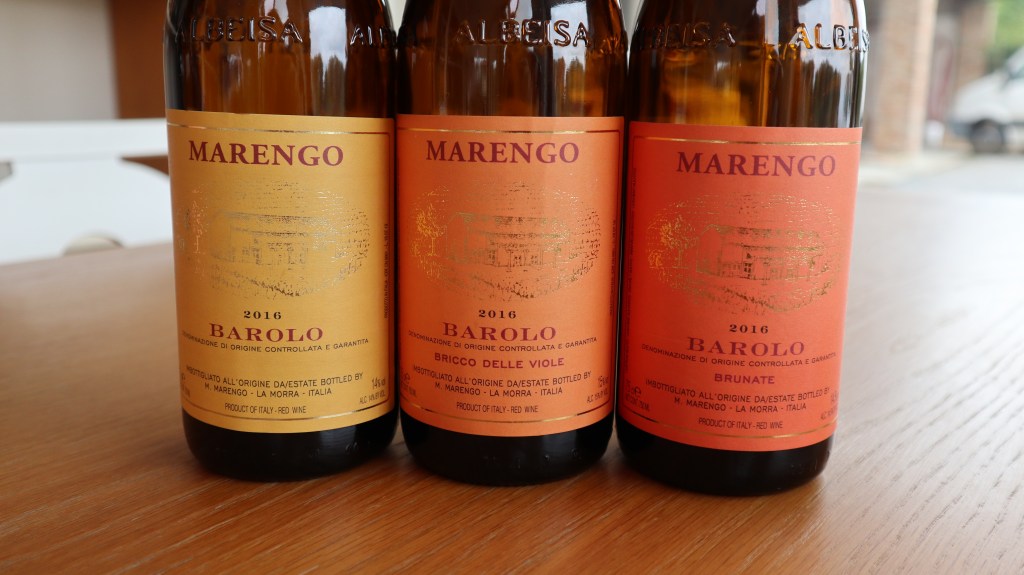
Marengo Barolo Smells just like a Barolo should, with notes of roses, leather and fruit. Smooth tannins that disappear quickly.
Marengo Barolo Bricco Delle Viole A more floral nose compared to the classic, with hints of roses and violets. More tannins than the classic as well.
Marengo Barolo Brunate Holy tits on toast. Those were my exact notes. A beautiful nose – floral and fruity. Elegant tannins, very smooth. This wine has huge potential.
Mauro Veglio Barolo Subtle nose with notes of spices, leather, flowers. Tastes just like a Barolo should taste – elegant and balanced. A big powerful wine, yet elegant, with a long finish.
Mauro Veglio Barolo Arborina Smells like Arborina, a beautifully feminine wine. Notes of rose petals with a hint of leather. An impressive Barolo that’s smooth in the mouth. Arborina tends to be more direct/vertical than Gattera.
Mauro Veglio Barolo Gattera Slightlymore masculine than Arborina. Notes of wet soil, spices, leather on the nose. Bigger tannins, rounder, more complex than the Arborina.
Mauro Veglio Barolo Castelletto Very spicy nose. Notes of tar and forest floor. More tannins and more structure than Arborina and Gattera.
Mauro Veglio Paiagallo Mauro Veglio Barolo Paiagallo 2016 has a very elegant nose of red berries, mainly strawberry and raspberry. The wine is powerful but elegant. Remarkably soft tannins!
Mauro Molino Barolo Bricco Luciani Feminine with smooth tannins. Red berries and floral notes.
Nadia Curto Barolo La Foia More tension than 2015. Fresh and crisp. Big but elegant.
Trediberri Barolo Roses, tobacco and tar. A wonderful, big Barolo. Might need some time in the glass to open up.
Vietti Barolo Perfect Barolo nose! A powerful wine with big tannins but they disappear quickly and you’re left with wonderful fruit.
Vietti Barolo Lazzarito Fresh nose, very fruity and floral with hints of spices and forest floor. Good structure.
Vietti Barolo Ravera Balsamic nose with hints of leather and licorice. Spicy in the mouth with a long finish. This wine needs time
Vietti Barolo Brunate Beautiful nose – floral, elegant, fruity. Powerful but also elegant. Long finish.
Words used to describe Barbera 2018: supple, mid-weight, lighter. In 2018, rain was concentrated principally during the initial period, in the month of May, a critical moment in the growing season. Cool weather dominated the first half of 2018, but higher temperatures came and the good weather persisted through the harvest period.
I found the Barbera 2018 to be quite balanced, with good acidity and good fruit. Below are some of the Barbera’s I’ve recently tasted.
Barbera 2018 – Tasting Notes
Andrea Oberto Barbera d’Alba 100% Barbera, 3-4 months in 3rd passage oak (barrique), followed by aging in steel tanks. Good acidity, with lots of fruit. A very good Barbera.
Burlotto Barbera Aves The Aves is quite high in alcohol, but you don’t feel it in the mouth. Good acidity, with notes of cherries and dark fruit.
Cascina Fontana Barbera Barbera, the Mario Fontana way! Aging 50% barrique, 50% cement for 12 months, blend after aging. Mario releases his Barbera after one year in bottle. A very fresh wine with good acidity. Notes of darker fruit and wet forest floor.
Cristian Boffa Barbera 100% Barbera from 3 different vineyards, with the age of the plants ranging from 15 to 50 years old. Aged 6-8 months in mostly used barrique. You can feel the alcohol a little on the nose and the mouth. Not your typical Barbera, probably because of the age of the vines. Notes of licorice on the nose.
Diego Morra Barbera Aged 4-5 months in tonno, with a small percentage of new oak. Good acidity. Red fruit and cherry notes, with hints of oak. A mineral Barbera that’s quite round in the mouth.
Gianfranco Alessandria Barbera Barbera 2018 has smaller character than 2017 and 2019. Notes of darker berries, like plum. A balanced wine with good acidity.
La Vedetta Barbera d’Asti Sarasino A Barbera from Asti, with grapes coming from a hill called Sarasino. Red fruit and cherry notes. This Barbera has quite high acidity.
Marengo Barbera You can feel the oak on the nose, not in the mouth. Notes of Strawberry on the nose. A very balanced Barbera with good structure and good acidity.
Vietti Barbera Tre Vigne Beautiful nose with aromas of red cherry and fresh red fruit. Crisp with good acidity and good structure. A balanced wine with a long finish!
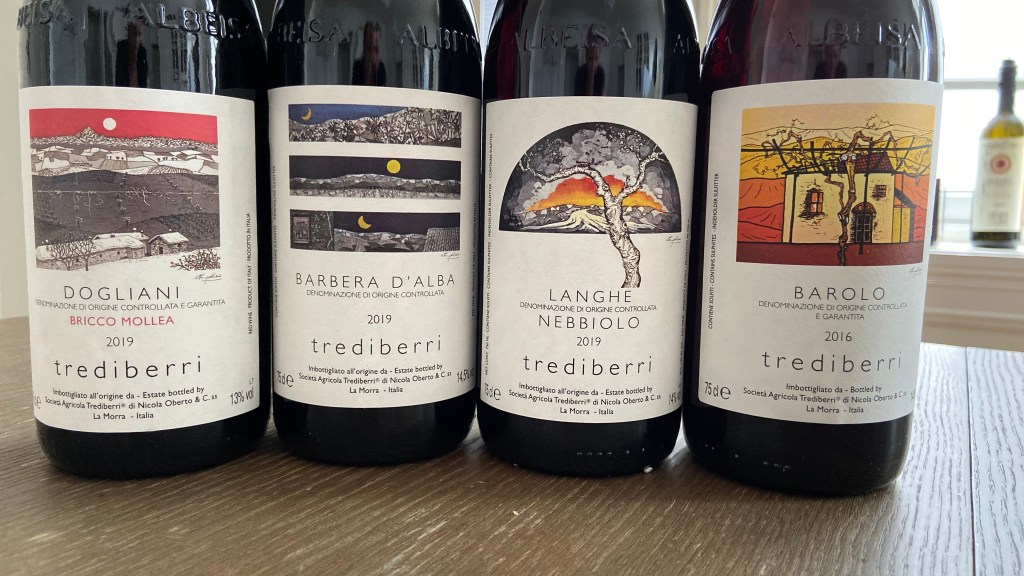
Introducing: Trediberri Bricco Mollea & the new vintages! It’s always exciting when the new vintages are released, and we are all eagerly anticipating the 2016 Barolo’s. But I have to say I am also really excited for the new addition to the Trediberri family – a Dogliani Dolcetto!
The Bricco Mollea vineyard is located in Vicoforte, far south in Langhe. Dolcetto’s from Dogliani tend to be more intense than Dolcetto’s from La Morra, and if you combine the terroir with the 62 year old plants, you get a complex and intense Dolcetto. Note, when I say intense it’s not intense in a bad way. Quite the opposite actually. The Trediberri Bricco Mollea Dolcetto is fruity and rich; a beautiful expression of the grape variety.
Please, every sip you drink, be happy
Nicola
Trediberri Bricco Mollea Dolcetto 2019
The Dolcetto grapes grow in Vicoforte, near Mondovi, in the southern part of Langhe. The vines were planted in 1958, which mean the plants are about 60 years old. It’s a 100% Dolcetto, fermented in concrete.
The first thing I notice is that beautiful Dolcetto nose. And explosion of dark berries. The 2019 vintage seems to be a bit more intense than 2018, and the intensity continues in the mouth. It’s still a fresh and fruity Dolcetto, with a pure expression. A wonderful first edition of this wine.
Barbera d’Alba 2019
Trediberri’s Barbera is 100% Barbera, fermented in concrete tanks. Barbera is known for being lush and bold – it likes hot weather, it likes concentration, it likes being big. But the Trediberri Barbera is more pure. It’s less bold, with a fresh fruitiness. There’s also a very good acidity.
Langhe Nebbiolo 2019
The grapes in the Trediberri Langhe Nebbiolo come from the Berri vineyard, from a vineyard in Alta Langa, and 10% of grapes from Roero to give a hint of perfume.
Consistent with other 2019’s I’ve tasted, the Langhe Nebbiolo has an explosive nose. Very fruity, floral and fresh. Red fruit dominated, but there are notes of roses and tobacco. Firm but elegant tannins that disappear quickly.
Barolo 2016
The Nebbiolo grapes go through a 3 week maceration in concrete tanks. Trediberri Barolo 2016 has a typical Barolo nose: tobacco, tar, roses. It’s a little subtle at first, and needs time to open up. A big wine yet elegant at the same time. As Antonio Galloni said, “This is an especially potent vintage for the straight Barolo, and there is clearly so much going on in the glass; it is a superb wine in the making.”
 PIEMONTEGIRL